The motion at your ankle is primarily up and down as your
run. Extensor muscles in the front of
your leg lift your toes up as your foot leaves the ground and flexor muscles
give you the push off that springs you forward.
Medial
and lateral ankle ligaments hold the ankle joint steady on the inside and
outside portion of your leg throughout these motions. While these ligaments are holding your ankle
in place they are not under much tension when running on smooth surfaces. Because
these ligaments are not stressed with side to side motion as they would be in
sports such as soccer, basketball and others, they can become weakened and fail
with the slightest misstep. It is important to keep these ligaments healthy
with variations to your routine.
Dedicated and committed to the health of the feet and ankles of Austin, Texas runners.
Showing posts with label ankle injuries. Show all posts
Friday, March 23, 2012
Marathon training – Ankle strength is important
Completing a marathon is a physical feet that requires much
preparation to safely accomplish. If you
have qualified for the Boston Marathon on
April 15, we hope you have built up your foot, ankle, and leg strength in
addition to your stamina and distance. The many
demands of running 26.2 miles can put enough stress on anyone’s feet,
ankles and legs to create injuries. With proper
marathon training you have built up your legs to withstand these distances,
but neglecting any component of your stride can have disastrous results over
this distance. We want to draw attention to your ankle today as it is one of
the most common injuries to affect anyone.
There are many exercises you can add to your routine to help
strengthen your legs and ankles. Yoga
is one area we have discussed before to strengthen, stretch, and improve
the overall health of your legs and feet.
Luckily many of the poses required in yoga demand balance, something
that can force your ligaments to stay strong. Balance exercises are actually a
crucial part of rehabilitating
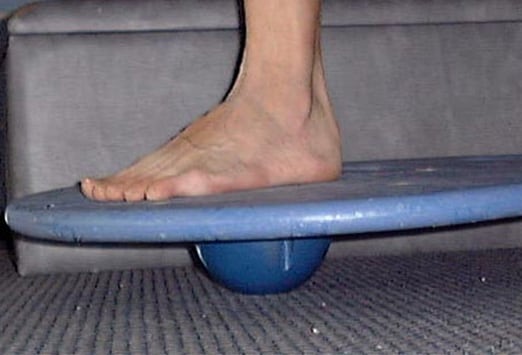
an injured ankle. Often standing on soft or slightly unstable surfaces,
like a trampoline or balance board, can provide enough resistance to keep your
ankle ligaments strong and healthy. Including strengthening exercises in your
training can be an important to preventing injury for any type of runner, but
especially long distance runners.
Tuesday, December 28, 2010
Ektio’s New Shoe – Preventing Ankle Sprains
This month Ektio released their line of basketball shoes. The claim is that their basketball shoes are the ‘first physician-designed athletic shoes that provide rock solid ankle support without inhibiting mobility.’ Their shoe, endorsed by former NBA New York Knicks player John Starks, will premier in the Amazon marketplace in January and is already found at some retailers. The serious basketball shoe fanatic probably spends a lot on athletic shoes and may not flinch at the ~$200 price tag for either the Wraptor or Post-up styles, but others may be more hesitant.
We have discussed ankle injuries in the past. While all joints are at increased risk of injury due to stress and movement, the ankle is probably the most prone. It is one of the few joints that allows for movement in three directions. Unfortunately, when playing certain sports, like basketball, some of these motions become exaggerated and can lead to injury. This shoe is being marketed towards the athlete because of their increased incidence of ankle problems, but many of us who don’t play basketball can relate to ankle problems. In my high school basketball days, I remember trying to lace my high tops just right to try and not hurt my ankle. These shoes claim to make such worries and most ankle injuries a thing of the past.
The makers of this shoe have some high aspirations. We all know ankle injuries can take time to heal and professional NBA players don’t want to be sidelined with injury. We at AFAS haven’t tests these shoes ourselves and can’t comment on the ‘rock solid ankle support’, but only time will tell whether the company’s claims are true or not. Regardless, it is important to remember that with all new footwear make your change a gradual one. Never start a new sport or activity without adequate preparation and conditioning. Failing to do so can make you prone to injury. In the case of any ankle injury, implement the RICE principle and make a visit to see Dr. Thomajan.
Until next time, keep those feet happy and healthy in the New Year, Austin!
Thursday, October 28, 2010
Brett Favre – A warning on ankle injuries
We are halfway to the NFL’s Week 8 and there are a number of high profile quarterback’s whose seasons have become questionable. Tony Romo, who may not recover from his shoulder injury until the last few games of the season, and Brett Favre, who severely injured his ankle, are just two of them. While there may not be a lot of us rooting for the Vikings, the career achievements of Brett Favre have made him a much publicized player. Records including most consecutive starts by a player, most consecutive wins, and most career playoff completions just a few of a long list of achievements for him. The latest injury to the aged player caused him to limp off the field after a loss to the Packer’s on Sunday. This injury may cause him to end his streak of consecutive starts as well as his ability to be an effective player.
He may be the first one to admit that he’s ‘no spring chicken anymore.’ As with any older individual, it takes your body a little longer to heal than it may have when you were younger. Brett Favre, at around $1 million per game salary, isn’t your average 41 year old and has expressed a desire to play through the pain. While it has been reported that he can’t do further damage to the broken bone by playing, we here at AFAS have our reservations. This week he has been seen in a walking boot to help off load the ankle allowing it to rest and heal. While rest is important, it may be of no use if he rests all week only to jump into a game on Sunday. This athlete has played through injury before, and his high profile status may bring him to do it again, but at what peril to his health and performance?
This should be a word of warning to any ‘weekend warriors’ out there who are anxious to bounce back from an ankle injury. You must be sure to give your injury ample time to heal. Additionally, you should slowly work up to your activity with the proper exercises and physical therapy. Conditioning your body for your activities is the best way to prevent initial or recurring injuries. Failure to properly rehabilitate an injury can cause re-injury and continued complications…..even for professional athletes.
Until next time, keep those feet (and ankles) happy and healthy Austin!
Subscribe to:
Posts (Atom)