The motion at your ankle is primarily up and down as your
run. Extensor muscles in the front of
your leg lift your toes up as your foot leaves the ground and flexor muscles
give you the push off that springs you forward.
Medial
and lateral ankle ligaments hold the ankle joint steady on the inside and
outside portion of your leg throughout these motions. While these ligaments are holding your ankle
in place they are not under much tension when running on smooth surfaces. Because
these ligaments are not stressed with side to side motion as they would be in
sports such as soccer, basketball and others, they can become weakened and fail
with the slightest misstep. It is important to keep these ligaments healthy
with variations to your routine.
Dedicated and committed to the health of the feet and ankles of Austin, Texas runners.
Friday, March 23, 2012
Marathon training – Ankle strength is important
Completing a marathon is a physical feet that requires much
preparation to safely accomplish. If you
have qualified for the Boston Marathon on
April 15, we hope you have built up your foot, ankle, and leg strength in
addition to your stamina and distance. The many
demands of running 26.2 miles can put enough stress on anyone’s feet,
ankles and legs to create injuries. With proper
marathon training you have built up your legs to withstand these distances,
but neglecting any component of your stride can have disastrous results over
this distance. We want to draw attention to your ankle today as it is one of
the most common injuries to affect anyone.
There are many exercises you can add to your routine to help
strengthen your legs and ankles. Yoga
is one area we have discussed before to strengthen, stretch, and improve
the overall health of your legs and feet.
Luckily many of the poses required in yoga demand balance, something
that can force your ligaments to stay strong. Balance exercises are actually a
crucial part of rehabilitating
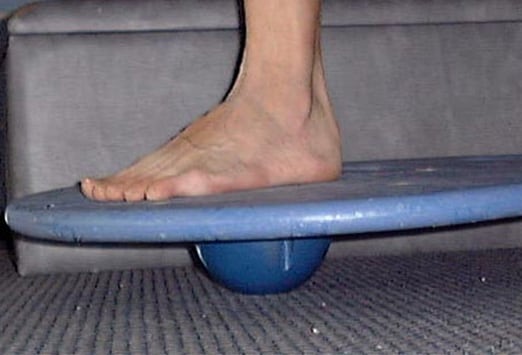
an injured ankle. Often standing on soft or slightly unstable surfaces,
like a trampoline or balance board, can provide enough resistance to keep your
ankle ligaments strong and healthy. Including strengthening exercises in your
training can be an important to preventing injury for any type of runner, but
especially long distance runners.
Thursday, March 15, 2012
Runner’s Knee – Tips for prevention
Runner’s knee, or patellofemoral
pain syndrome, is one of the most common overuse
injuries. This malady isn’t
reserved only for runners but rather can result from many sports including
skiers, soccer players, or any other sport that put high demands on your knee. It occurs when patella, better known as your
knee cap, causes irritation of the femur, or the large bone underlying the
muscles of your thigh and hamstrings. Normally the ligaments and muscles of
your leg hold everything in proper alignment allowing the two bones to glide
past one another. There are several factors that can contribute to ‘throw a
wrench’ in this efficient function.
Overuse can cause muscles to weaken and put you at risk
for injury. Without proper periods of rest and nutrition, our bodies cannot
build or repair the muscles fibers that are affected during our runs. 24 hours between runs, with a good night’s
rest and a decent diet are often enough to prevent overuse, but each of us are
different and need to make adjustments accordingly. Additionally, our muscle groups almost always
pull against or counteract another group.
When we fail to work both groups appropriately, one group may gain an
advantage over the other. Unfortunately, imbalance or weakness in any of the
components that act on your knee can lead to this pain condition.
Prevention can be as simple as running
smart. Allow for sufficient rest and
slowly increase the distances you run. In addition to eliminating the overuse
component by doing this, you can be proactive in keeping your muscles strong
and preventing imbalance. Implementing strengthening
exercises for your lower limbs is just as important as stretching when it comes
to preventing runner’s knee. We recommend exercises to strengthen your ‘quadriceps’
and ‘hamstrings’ as they act on your knee.
Keeping these
two muscles groups stretched and strong will do a lot to keep imbalance
from occurring. Problems can always
occur despite your best efforts. When a
few days rest don’t improve the pain, make a visit to see your Austin podiatrist. There are a variety of bracing or shoe
inserts that can be used to keep you in proper alignment and allow your painful
knee to resolve.
Thursday, February 16, 2012
Form and Function – Foot structure and running style
A recent
article out of Pennsylvania State University kinesiology
research shows that sprinters and
non-sprinters have measurable differences in their foot structure and the
muscles affecting them. With a
relatively small sample size, 16 runners, they compared MRI images to find
shorter Achilles tendons and longer ‘big toe’ bones on average in sprinters
than in non- sprinter runners. The men
examined in the study were all active athletes of several years duration. The rational of a more efficient lever arm because
of these findings is interesting for kinesiologists, but somewhat misleading
from our point of view.
Shortening of
the Achilles tendon may contribute to greater speed in competitive sprinters,
but it can have detrimental
effects in the long term. The
metatarsals are the long bones behind your toes that take up a good portion of
your foot. They do create a lever action where they meet the toes during normal
heel to toe walking or running. When
instead, as in sprinting or wearing high heels, they take the full force of
your body weight on one leg problems can occur. It is true that the tendons and
muscles transfer the force through your foot and up your leg as the barefoot
philosophy relates. Unfortunately, without carefully building up the muscles or
bone tolerance, fractures can and often do occur. Spending too much time on
your toes either in heels or while running can lead to stress
fractures or actual breaks in your metatarsals
This isn’t to
say that sprinting or barefoot
running doesn’t have a place in your running regime. Implementing these things as a part of your
running routine can help to diversify and build on your abilities. We strongly
encourage you to implement a variety of stretching
techniques to keep any of your leg muscles from become tight or
contracted. It is a good idea to see
your Austin podiatrist to
address any concerns or problems with your running regime. Be sure to slowly introduce changes to your
running regime and limit the amount of time you spend on the balls of your feet.
Thursday, January 26, 2012
New Runners - Running in Austin is a Year Round Event
While other parts of the country a buried under inches or feet of
snow or dealing with sub zero temperatures this time of year, we Austinites can enjoy
being outside year round. Yes, the
temperatures can dip into the teens on that rare occasion, but running outside
is almost always an option. If improving your health is part of your
resolutions for this year, running is one of the simplest ways to do it.
In addition to shedding fat, adding muscle, and improving
cardiovascular health, this activity will help increase the strength and
density of your bones. Many people,
especially women, will lose bone density with age. Running
is a great way to build that density up and keep your bones strong which will
make them more resistant to breaks.
There are many activities that one can do to stay healthy, but, as we pointed
in this
month’s newsletter, few others require less equipment. Strap a good pair of running shoes on your
feet and you have a wealth of many different trails and paths to run on in the
area. No gym membership required! Do pay
attention to the type of surface you are running on. While it may be easiest to run on the
sidewalks in your neighborhood, concrete can be very demanding on the joints of
your legs and feet. Instead, consider a
dirt trail or designate running track as a new runner. Running on a softer surface will give your
body opportunity to adjust to the new demands placed on it.
Before you join the large community of Austin runners, make a
visit to your family physician. A
regular check up is a good way to catch any possible problems before the increased
demands can cause damage. Likewise,
make an appointment with your Austin podiatrist to
investigate any minor aches or pains.
That mild ache in your heel or nagging stiffness in your toe can become
very painful, very quickly if not cared for before you begin running. Too often foot pain and limit or prevent you
from participating in various activities.
Unfortunately, many of these pains can be eliminated with proper
treatment by a podiatrist. A proper
evaluation of your feet can also help you to select the proper running shoes
for your foot type. Take the time to
properly prepare yourself now and you can enjoy your runs for years to come!
Related articles
- New running shoes for the new year - Know your foot type (austinfootandankle.blogspot.com)
- Why the health of your feet is a priority (austinfootandankle.com)
Sunday, January 15, 2012
Dwayne Wade – Heel Pain & Ankle Sprains
Miami Heat’s Dwayne
Wade returned to action on Tuesday after missing 3 games and many practices
over the last week. He had been ‘taking
it easy’ during that time in order to recover from heel pain. The team had reported he was recovering
from a ‘bruised foot’ that occurred against the Charlotte Bobcats. When the injury
didn’t resolve after a week, Wade speculated that the injury may be his plantar
fascia. Whether he was fully recovered
or not Wade seemed to have any problems in the game against the Golden State Warriors. Unfortunately, the team hasn’t secured a win
since his return and Wade’s injuries have mounted. He strained his calf against the LA Clippers on Wednesday
and sprained his ankle Friday against the Denver
Nuggets.
Wade was concerned that he may have broken something as he’d
‘never sprained it like that before’. With
any ankle injury, it is important to rule out fractures with x-rays. NBA players are liked to get to an x-ray quicker
than you or I, but it is important to RICE (rest,
ice, compression, elevation) any kind of ankle injury as excessive swelling
can often make the problem worse. Your
body uses swelling to supply healing nutrients to the site and protect it. The ankle joint often cannot easily accommodate
large amounts of swelling and can complicate the injury. For ankle injuries like this, an early
treatment would be an injection to the ankle with a local anesthetic to relieve
pain as well as a corticosteroid to help reduce swelling. Doctor’s will most likely recommend early
physical therapy as ankle sprains can become chronic if not treated
aggressively.
While the ankle injury appears to have occurred on its own, we
have to wonder if the heel pain played any part in problems over the last few
games. Heel
pain can have many causes and all are not as straight forward as we have
tried to point out before. A thorough
evaluation by a podiatric
physician will identify the cause of your pain and the best course to correct
it. We hope Mr. Wade heals quickly and
is able to get back on the court.
Wednesday, January 11, 2012
New running shoes for the new year – Know your foot type
Most of us have probably found a brand of shoe that works better
for us than another. Since each shoe company uses a different design for the
sole this is not surprising, but even within a brand there can be much
variability in the support and structure of different styles. Shoes designed for cross training or hiking
need to provide more side to side stability, where those designed for running
are focused on energy transferred from heel to toe. Within the styles of running shoe, we can
further look at the amount and type of support to address the motion of your
foot. Pronation, or the motion of
pressure from outside heel to the inside ball, can be exaggerated in some
individuals. Because an excessive amount
of motion in this manner can cause problems, Austin
Foot and Ankle Specialists recommends these shoes based on your foot. A thorough examination of your feet in our
clinic can provide you all the information you need to select the proper
footgear.
Foot pain can often be caused simply by the structure of your
foot. The normal foot exhibits an arch
on the inside when standing normally. A
foot with a very
high arch is cavus, and a foot with no arch, or flat
foot, is planus. Most individuals
fall somewhere between these two extremes, but knowing which extreme your trend
towards can help you from incurring the aches and pains that can come from
putting then in the wrong shoes. Often
the right type of padding or support in the right places will be enough to keep
you running, but many
options are available to correct painful foot structure through your Austin
podiatrist.
In addition to our website,
there are a variety of sources out there to help runners with shoe selection. The American
Association of Podiatric Sports Medicine has an extensive list of shoes
based on the support they offer as well as other advice for the runner. The APMA
has a webpage devoted entirely to the runner. You can also find a link here
to guide your shoe selection
based on arch height.
Wednesday, December 7, 2011
Heel pain due to weight gain
| Image via Wikipedia |
This can often become a compounding problem. The more weight you
gain, the more heel pain your may have and more heel
pain you have the less likely you are to exercise those pounds away. While there are a variety of exercises, such
as swimming and biking, that are not limited by heel pain, we must admit that
for most of us these options are not as easy as walking or running. Strapping on a good
pair of running shoes and taking a lap or two through your neighborhood is
about as easy as it gets. Remembering to
do proper stretching of your feet, especially the plantar fascia, as
well as your legs can help to keep the loose. Heel pain can often be the result
of tight ligaments and muscles. Foot
pain can quickly limit this and should not be ignored.
This can be a very demanding time of the year. The last thing you need is heel pain limiting
your activity. An evaluation by Austin Foot and Ankle Specialists
can identify the source of your heel pain and get you back to your activities
pain free. There are many
different causes of heel pain beyond weight gain and tight tendons so a
thorough evaluation is necessary to avoid more serious problems. A
variety of treatments are available through your Austin podiatrist. Don’t delay in having your heels feeling good
for the holidays!
Subscribe to:
Posts (Atom)